

Every Artwork Has Two Histories

Hey, hello there, friend,
As an artist, one of the greatest privileges of my career has been hearing the stories behind why someone chooses to bring a painting home.
Sometimes it marks a new beginning, a reminder of a person they love, a place they never want to forget, or simply a feeling they want to experience every single day. Years later, collectors often tell me those stories have become just as meaningful as the artwork itself.
That's why I loved this article by Suzie Wilson. It reminds us that collecting art isn't only about preserving the artwork, it's also about preserving the memories, emotions, and chapters of life that made it matter in the first place.
I hope it inspires you to document not only what's hanging on your walls, but also the story of why it belongs there.
Article by Suzie Wilson
Why Art Collectors Should Preserve the Story Behind the Collection
Art collectors often devote considerable care to documenting provenance, purchase prices, certificates of authenticity, and condition reports. Yet the most personal part of a collection is frequently left undocumented: the story of why each artwork mattered in the first place. Years later, even experienced collectors can struggle to remember what first drew them to a painting, the conversation that sealed the decision, or the season of life that gave the work its meaning.

At a Glance
● The emotional story behind an artwork is often more fragile than its paperwork.
● Recording memories while they're fresh preserves context that cannot be reconstructed later.
● A thoughtful collection becomes a personal autobiography as much as an art collection.
● Practical records and personal reflections complement one another.
● Future family members, curators, and heirs gain a deeper understanding of the collection when both are preserved.
When the Most Valuable Part Quietly Disappears
Collectors rarely forget purchasing a major piece. What fades is everything surrounding that moment.
The gallery where the afternoon unexpectedly stretched into hours. The artist describing a subtle detail that changed how the work was seen. The hesitation before deciding to bring it home. The life event that made the artwork feel especially significant.
Memory naturally compresses over time. Decades later, provenance may still be intact, but the emotional landscape surrounding an acquisition often disappears. Those details cannot be recovered from invoices or catalogues.
Without them, a collection risks becoming a series of beautiful objects rather than a record of a life thoughtfully lived.
A Collection Can Become a Personal Memoir
Rather than thinking of collection records as administrative files, many collectors benefit from approaching them as a quiet autobiography.
Each acquisition reflects more than aesthetic taste. It marks changing interests, relationships, your travels, careers, and milestones.
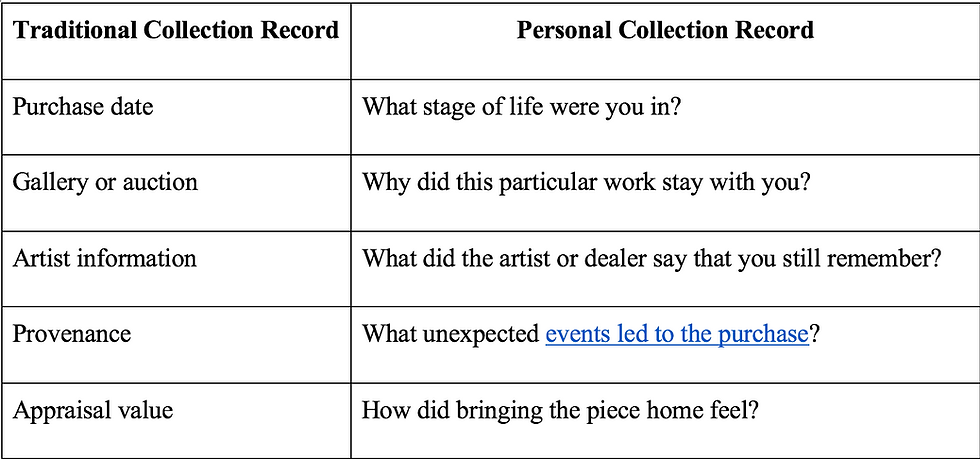
Together, these perspectives create a richer history than either could provide alone.
Details Worth Capturing Before They're Forgotten
Some memories seem unforgettable until enough years pass. Recording them soon after acquiring a piece helps preserve the texture of the experience.
Consider noting:
● The city, season, and setting where you first encountered the artwork.
● What was happening personally or professionally during that period.
● The first emotion or thought the piece inspired.
● Conversations with the artist, curator, or gallerist.
● Why you chose this work instead of another.
● Whether the purchase was carefully planned or wonderfully unexpected.
● Where the artwork was first displayed in your home.
● How your relationship with the work has evolved over time.
Small observations often become the most meaningful years later.
A Simple Way to Build a Living Collection Record
You do not need elaborate software or a formal archive to begin.
A practical approach:
2. Record the essential provenance information.
3. Write a short personal reflection while the experience is still fresh.
4. Save related correspondence, exhibition catalogues, and photographs from the acquisition.
5. Revisit the record occasionally to add new reflections as your connection to the work develops.
Even a few thoughtful paragraphs can preserve memories that would otherwise disappear.
Protecting Both the Personal and the Practical
Alongside personal reflections, collectors often maintain appraisals, purchase receipts, certificates of authenticity, insurance documents, and estate planning records. These files are increasingly shared with insurers, attorneys, financial advisers, or trusted family members, making privacy an important consideration.
One practical solution is to secure sensitive documents before sending them electronically.
Free online tools that let you password protect PDF files make it easier to safeguard valuation records and ownership documentation while allowing the personal stories behind a collection to remain separate from confidential financial information. In this way, both the emotional and administrative histories of a collection can be preserved without unnecessary exposure.
Looking Beyond Ownership
A meaningful collection often continues speaking long after its original collector is gone.
When future generations inherit artworks without context, they receive objects. When they inherit the accompanying stories, they receive experiences.
Knowing that a painting celebrated a new beginning, marked a difficult season, or represented an unforgettable encounter with an artist transforms the viewing experience. It allows others to understand not only the artwork itself, but the person who chose to live alongside it.
A Helpful Resource for Recording Art Collections
Collectors looking for guidance on documenting artworks may find the Getty Research Institute helpful.
The Getty offers resources on provenance research, collection documentation, and preserving historical context that can inspire more thoughtful personal record-keeping.
Learn more at:
Frequently Asked Questions
Should every artwork have a written story?
Not necessarily, but even a few sentences about why a piece mattered can preserve memories that become surprisingly difficult to recall years later.
How long should each entry be?
There is no ideal length. Some pieces may inspire only a paragraph, while others deserve several pages.
Should personal reflections replace provenance records?
No. Personal narratives and formal documentation serve different purposes. Together, they create a more complete record of a collection.
Is it too late to start documenting an existing collection?
Not at all. Even if some memories are incomplete, recording what you remember today is far better than waiting until even more details fade.
Conclusion
An art collection tells two stories: the artist's and the collector's. Provenance explains where an artwork has been, while personal reflections explain why it became part of a life. Preserving both creates a collection that future viewers can understand not only with their eyes, but with genuine human connection.
___
Leave you comment below!
Color Your Life!
Drica


Comments